
An Interview with Dr. Alyson Melzer
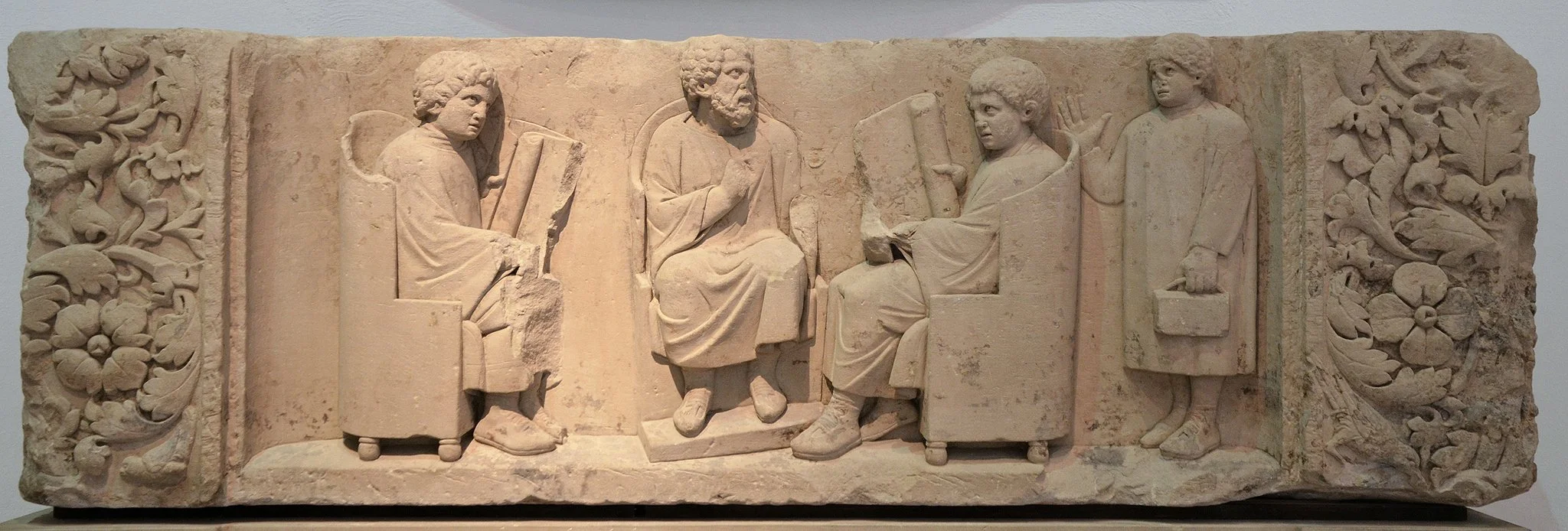
Roman Teacher with Three Discipuli, Funerary Relief, Rheinisches Landesmuseum, Germany.
By Musings Staff
On November 10, 2025, UC San Diego’s Center for Hellenic Studies welcomed Dr. Alyson Melzer, an assistant professor in Classical Studies at the University of Indiana Bloomington, as a guest speaker for a talk entitled “Tragedy you Seem to See: Ancient Literary Receptions of Fifth-Century Theater.” Grace Koumaras, co-president of Pandora Forum at UCSD, sat down with Dr. Melzer before her talk to learn more about her journey in the world of Classical Studies.
The following is an edited transcript of the interview.
KOUMARAS: So… who are you? Tell us a little about yourself, your journey with Classics, and what got you interested in the field.
MELZER: Great question! So, I’m an assistant professor in Indiana. This is my fourth year there, so I’m still — in terms of university people — a new person on the campus. But before that, I spent a year as a visiting professor at Notre Dame, and before that, I was at Stanford. That’s where I got my PhD; that’s where I met your friend, Professor Kelting. My PhD was in Greek Literature, but I actually came to Classics late! Later than all of you, actually. You’re all ahead of the game.
In college, I was a music major, and I played the violin. But, I started taking some classes in translation of Greek literature, and I really got into it. Once I graduated, I actually started taking some Greek and Latin full-time, just trying to figure out if I liked it before going to UCLA for a few years to prepare for the PhD. So, yeah! It’s kind of a backwards route, but one that I’m glad I took, and it brought me here!
KOUMARAS: We’re actually very similar! I didn’t know you were a music major. I was a music major… I went through a lot of majors here. I got admitted to visual arts, but I went to music first, and I played harpsichord here for two years.
MELZER: Oh, that’s amazing!
KOUMARAS: So, starting out with an open question, what do you believe makes a good translation?
MELZER: Ooh! I like that question, because I think it depends, really, on the context.
Because I am a researcher, I often am looking at the original Greek. But to look at a translation, I want it to be as close to the original Greek as possible. [You want to find something] very literal, because you’re trying to get a sense of — as close as you can to — what the ancient person would have been reading.
But I take a very different approach in teaching contexts, when I want something that feels more accessible. In those cases, the important thing is translating experiences rather than the language literally. You need to do what you need to do to the text to create similar sorts of impressions, or moods, or atmospheres, or messages as the ancient text would have communicated them. And that, I think, sometimes requires liberties taken with the translation to create that effect. Sticking to the original, I think, oftentimes will make it feel to modern audiences stodgy, or old and dry.
I think about this a lot: in tragedy, there are these cries, perhaps you’ve seen them. They’ll just be, like, an exclamation or a scream, but they’re written out in Greek as letters. And we suspect that the ancient person, probably, in the play would’ve just screamed or done something. But then, in a translation, it will say, “alas,” or something. Which maybe, in a time, would’ve communicated intense emotions. But now, I feel, if you get an “alas” you’re not feeling a gut-wrenching cry of pain. So you should do something else – that is, taking more liberties, or finding some way to get that emotion in there.
So, yeah, that’s the kind of longer answer. I’m always curious to hear what students think too, though, about what appeals to them. Because I know some students do like the experience of, like, “This is an old text; I want it to feel old while I’m reading it.” And so then, maybe, there’s room for an “alas”, or something like that to put you in the historical mindset. But I think it is probably a matter of taste to a certain extent, too… Yeah, I don’t know! I’d be curious to hear what some of you think.
[Lively conversation about translations occurs]
KOUMARAS: Great responses! As a precursor, you mentioned the “alas” earlier… That’s very tragic… So, why tragedy? And we’re talking, specifically, about reception and perception of tragedy. Maybe a little preview [for the talk later]?
MELZER: Sure, yeah! So, I originally went into grad school thinking I would write a dissertation about tragedy. I think it is very related, actually, to being a musician, and I’ve always been interested in performance and theatre.
I did not end up writing a dissertation about theatre, though, and what I’ve actually become more interested in lately is the reception of performance and of theatre in later phases of Greek history: when they’re still, like, reading a lot of these texts, and they’re still going to the theatre to see some things performed. But [later ancient Greeks] are less often engaging with [theatre] that way, right? They’re more likely to be reading these texts like we do. And there’s a lot of work in the ancient world of people – scholars, basically – studying these texts and writing essays about what they think makes them good and what they think makes them worth studying: how you can learn to write your own thing from them, things like that. So I got really interested in this group of scholars, because it’s an interesting way to think about ancient literature from the ancient perspective, basically! We do a lot of thinking about their literature that they also did too, and they’re especially interested in texts that were originally performed, like tragedy.
So, the talk today will be a sampling of that approach. We’ll talk about tragedy, but what I really want to think about is how ancient people are talking about tragedy. And specifically, how they’re experiencing it when it’s not in the theatre: you’re still having the experience of reading a play script, but you’re not watching actors deliver it for you. I’m really interested in that as a teacher — because it’s something we all do all the time, and without thinking too much about it — but also as someone who’s interested in an ancient literary culture: what Greek people liked, why they saved what they saved — a lot of the reason we have the text that we have still today to read in our classes is because of authors like this, who said, like, “Oh, this Sophocles guy, he’s really good!” And then someone would be like, “Oh, okay, we’ll copy down his plays.”
Because they’re writing everything by hand — and it’s very expensive and labor-intensive, you can’t copy everything — choices are being made. Some of those choices have to do with these groups of scholars, so it’s important to me to understand a bit about why we have certain texts and what their transmission history is: why ancient Greek people were saving certain things and not others, right? I think it’s easy, sometimes, from a modern perspective to be like, “Well, we just have the best stuff.” But, of course, it’s more complicated than that, right? All these kinds of transmission decisions are decisions that people made for various reasons. So, that’s a long way to answer your question, and it is part of what my talk will be about today. Today, we’ll think more specifically about the imagination, and how you imagine theatre being performed while you’re reading it. So, yeah!
KOUMARAS: Wow, that sounds interesting! On that same note, have you noticed any similarities in these concepts that you’ve been approaching in the material of tragedy? Is any of it similar to, like, ancient comedies? Or is there modern media that you notice is like kind of similar, or are there patterns you’ve picked up on?
MELZER: Between, like, ancient theatre and modern theatre? Or…
KOUMARAS: Between ancient tragedy and comedy?
MELZER: Oh, sure! It’s interesting, yeah, because a lot of these scholars that I study, unfortunately, don’t take comedy very seriously, which is kind of still how we deal with comedies in some ways. But, tragedies are where they find this philosophical, intellectual depth, and so they really want to study those a lot. And then, the comedies, you know, you see those come up more in discussions at drinking parties, or something like that, so they’re still definitely reading the comedies. It’s kind of an interesting pattern that starts early and still has implications in the modern world: tragedy as a genre versus comedy — even in TV or movies or whatever, right? Winning Academy Awards… it’s hard to do as a comedy, not as a drama. [laughs]
I wonder why that is. I guess because ancient Greek comedy is filled with dick jokes and farts, it’s just easy not to take seriously? [laughs] But, of course, ancient Greek comedy is incredibly complex. I don’t know if any of you have gotten to read Aristophanes or something? There are these very silly childish jokes, but then there is really serious engagement with their contemporary political culture, and there’ll be really complicated references to contemporary politicians and events, and the war, and things like that. And so, you know, that makes it, I think, really interesting to study. It’s interesting to study ancient comedy because you’re getting a really specific view into a moment in time. It’s possible then, though, that once you get into transmission and reading texts hundred of years, thousands of years later, the tragedies can feel a bit more — they’re dealing with raw emotions and family dynamics and things that can have more similarities in time versus, like, a politician at a certain point in time that this one comedian thought was rude, and making fun of him for a specific reason. [laughs] It’s harder to translate through time, right? Yeah, so, maybe that’s the same kind of thing with modern comedies and drama, that serious things aim for a more universal approach, at least broader than comedies. Especially in the ancient world, [where comedies can be] very specific, it’s interesting how they turn out [differently].
KOUMARAS: Yeah! So, when you’re reading plays or presenting on them, is there a certain facet of the literature that you find particularly interesting? Like, the narrative itself or historical context? Is there something that just strikes you more than the others?
MELZER: Yeah! I’m usually going after cultural context when I read ancient texts: trying to understand, to see what we can learn about the ancient Greeks through their literature, through their tastes and what interests them, but also how they present certain stories. So, yeah! I’m interested in trying to understand the past as best we can, and trying to understand people by means of the art they choose to celebrate — or the art they choose to suppress and not make and not identify with. That’s also an interesting way to go about it. Yeah, while there’s a lot to be gained, and I do spend time thinking about determining themes and character motivations and some of those more textual aspects of literary studies, I think I personally tend to default toward the cultural-historian use of literature as an artifact that you can study, as you would a sculpture or something like that, to understand the people who made it.
KOUMARAS: Ooh, yeah! On the note of cultural context, our club is defined on – or redefining – Classical Studies. What are your hopes for the future of Classical Studies? You can be as specific or broad as you want on this.
MELZER: My main hope is that it will continue, which sounds grim, but I think we can’t take anything for granted right now in terms of education in the humanities. I think that, recently, Classics has been trying to expand and reconsider what its boundaries are and what it values and why it values it, and I think that should continue.
The way a discipline like Classics can survive is [by] being reflective about what it is while also being proud of what it has to offer. There’s a lot to be gained from the ancient world, there’s a lot to be gained from a field like Classics that allows you to approach a moment in time from so many different angles. You can do archeology, you can do history, you can do philosophy, you can do literature; you can do all sorts of things that are oriented around a region and a few thousand years, which is nice! I think that’s a nice way to approach a people: as holistically as possible. And hopefully, that will just continue, because there are so many angles that you can approach a group of people from that are continuing to be expanded upon in Classics. You know, like, Gender Studies is much more of a thing now than it was even twenty years ago in the field, and there will hopefully continue to be more of that, if it continues to grow and attract different kinds of people than it historically has, which is something that’s also happened more in the field recently that’s good.
So, yeah! I think groups like this are the best way to do this, to get a lot of people involved at any level — casually, seriously, for a few hours, or the rest of their life, in my case. They’re all good, valid ways to keep something alive!
[The following portion is from our Question and Answer segment, where we opened up the conversation to fellow club members, including co-president Abby Baytieh]
BAYTIEH: Thank you so much for coming to speak with us! I really value being able to talk with professors like you, one-on-one. It’s really valuable for our club too, because Classics is already pretty small here, so it’s great to reach out to people like you. You come from a background of music, so my question to you is about when you’re reading texts. I have been in theatre for a while, and when I talk to people about Shakespeare, for example, oftentimes reading the text is a very different experience from watching it be performed live.
MELZER: Yes!
BAYTIEH: Where do you see the text being performed live versus it being read? Where do you find that valuable?
MELZER: Yeah! It’s hard, because the main time I’m interacting with texts and students is in class. I teach a theatre class, and if I had all the time and resources in the world, we would get together and read the sources out loud and find ways to watch performances of them, or at the very least listen to them, because in the ancient world, reading is always reading out loud, pretty much. For ancient Greeks, even if they’re alone, they’re listening. And so, finding ways to do more of that, I think, in a modern education context would be valuable, because we almost never do that — reading aloud, let alone reading and watching performances.
But, of course, the reality of my class is that we don’t have time to do any of that most of the time. We can read a little bit out loud, but yeah, I wish there were more ways. Even when I’m just trying to find clips to show a performance of Medea or something, it’s harder than you would want to find good clips that are of recent productions that are well done.
KOUMARAS: Hey, we’ve got a great one, if you want it.
MELZER: Hey, there you go! That’s right! I think this is probably a good example, then? Finding ways to do it in a low-stakes, casual, communal way — that’s always been my favorite way of dealing with theatre. It’s just like, in grad school, a group of friends who get together and translate a play, and put it on. It’s very low-budget and silly, and is just mostly for our friends, but it’s fun! And it’s rewarding, and you’re getting a different look into the text, even if you’re engaging with it in a kind of casual, silly fashion. Hopefully that was your experience with Medea as well!
BAYTIEH: Yeah!
MELZER: Yeah, it sounds like this daunting thing: “Oh, we’ve got to get costumes and spend all this money!” But actually, just reading it out loud can be fulfilling in some way. I want to hear more about this Medea! What was your experience?
KOUMARAS: I mean, honestly it felt embarrassing at first, because it was like, “I’m grown, why am I doing this?” Well, okay, “grown”... but, honestly, I think… I don’t know where I’m going with this…
BAYTIEH: We set it up as a table read, so we weren’t actually standing and performing it. I think that it was still very valuable to hear it happen, rather than just reading it.
KOUMARAS: Yeah, and [through reading aloud], you finally see the relevance of a chorus within a play, because they’re not really side characters, but they’re that omnipotent third eye that you’ve always wanted.
I think theatre is oddly successful for a really small organization like us. We also did something called Dionysia and Dine last year, and that was student performances related to Classical works. So we performed translations of Catullus and some other works: we did a modern perception of the Trojan War, and it was called the Pink Trojan Club, like the Chappell Roan song. So, we’ve just been finding ways we get people engaged now! It’s very camp, though.
MELZER: That’s great! That gets people excited!
KOUMARAS: Yeah! It’s, like, Classics are alive, they’re just different!
MELZER: They’re just different! But if you’re willing to meet them at their level, there’s a lot there. And it’s true: whenever I have these sorts of assignments in a theatre class where I’ll make students do a little performance, at first they feel embarrassed and they don’t want to do it. But then they get into it, and they’re surprised that they’re into it too. So, you just have to push past that initial discomfort, and it’s fun.
KOUMARAS: We were, like, yelling as Medea and Jason!
MELZER: Well, you have to!
KOUMARAS: And the camera was shaking from the audio.
MELZER: Wow, powerful!
KOUMARAS: Yeah, that’s Medea!
BAYTIEH: Did you share with us your favorite tragedy, or comedy, or play?
MELZER: Oh! No, I didn’t! I have a lot, it depends on the day, but I really like Euripides's Bacchae.
BAYTIEH: That’s a great choice.
MELZER: Dionysus is one of the most interesting things about the ancient Greek world, I think, and that play is wacky, and sometimes funny, and also very upsetting. It has it all!
KOUMARAS: Yeah, I think Pentheus’s death was one of the most upsetting ones — well, besides Dido, she’s very personal to me. But, I had to read that for one of our General Ed [courses] here, too, and it’s not just a strange introduction to everything in the ancient [world], but it’s definitely like, “Wow, this is… interesting… give me more, I guess!”
MELZER: I know! It was one of the first plays I read as well, and it’s crazy that that was the case and I [still] decided to do this job. It’s very messed up, but it is a kind of great introduction to the ancient Greek world, just in terms of their unflinching staring into the most intense human emotions that you can find.
KOUMARAS: Anything on your horizon that we should be more aware of besides your talk today?
MELZER: I’m working on a book right now, so that’s mostly where my tunnel vision is!
BAYTIEH: Is it secret?
MELZER: It’s not secret, no! It’s kind of along these lines of what I’ve been talking about: reading Greek literary criticism and ancient scholarship, and looking for elements of performance where we can find them from a lot of different angles — how theatre and music and things like that are being translated into a more academic context. So, yeah! That’s my main beat, which I’ll be doing a version of today!
And what a talk it was! Musings and Pandora Forum would like to thank Dr. Melzer for her time and her wonderful interview and lecture, and we are looking forward to following her research and publications.