
De Ortu Et Tempore Antichristi
By Novak Tatarevic
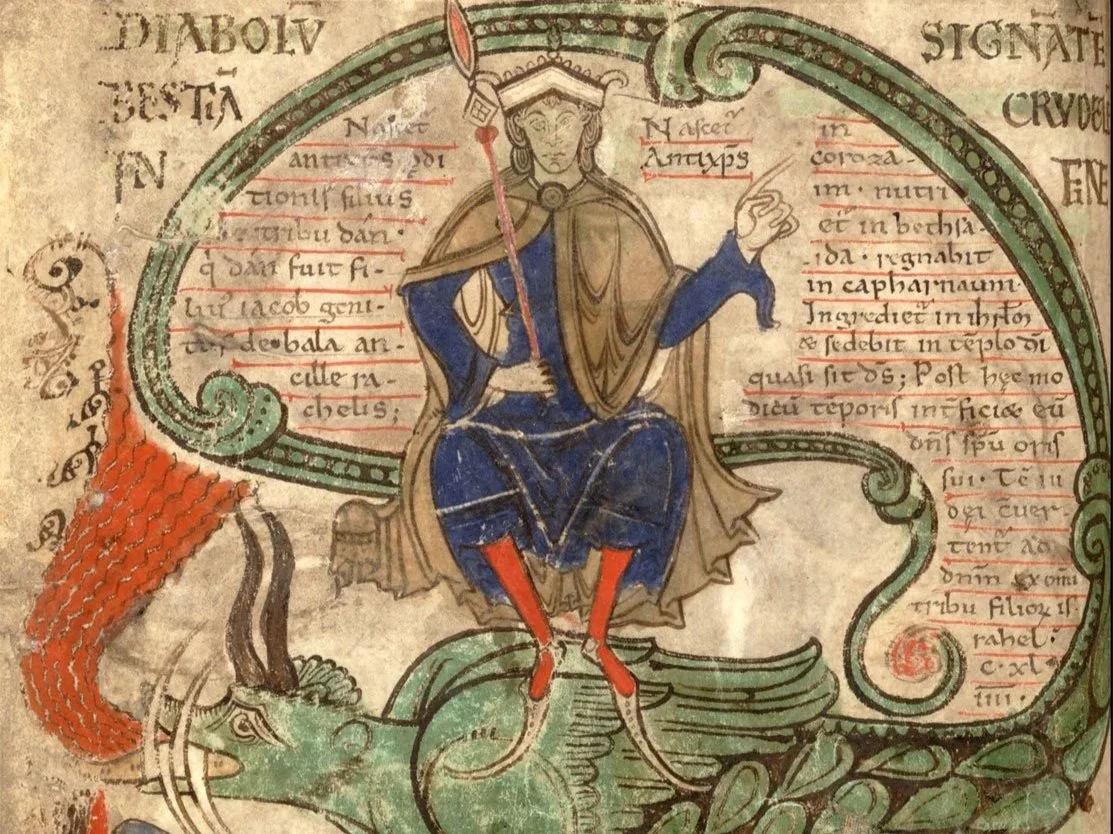
Liber Floridus (1120), “Antéchrist assis sur le Léviathan”, courtesy of Wikimedia Commons
Abstract:
In the mid-10th century, the monk Adso of the Abbey of Montier-en-Der responded to a request from the Queen of West Francia, Gerberga, to write a treatise on the Antichrist. Biblical commentaries and early Christian literature had already established a set of commonly accepted features of the Antichrist story, but with this information widely dispersed, interpretations varied and remained fairly inconsistent. Also, following the medieval tendency to compile and organize existing literature, as in the summa tradition, Adso assembled for Gerbrega a single narrative of the Antichrist from these disparate sources in the form of a vita, or hagiography. Partly as a result of this biographical framing, Adso’s work was widely influential and copied prolifically throughout the Middle Ages, and thus much previous scholarship has focused on Adso’s formula as the archetype of medieval Antichrist narratives broadly. Through a new and complete translation and commentary, I aim to demonstrate the intertextuality inherent to this compilatory approach and also the ways in which Adso’s narrative stands distinct from its constituent parts as a complete work.
Introduction:
The “Epistola Adsonis ad Gerbergam Reginam de Ortu et Tempore Antichristi” (A Letter of Adso to Queen Gerberga Regarding the Birth and Time of Antichrist) is a short treatise on the Antichrist written at the bequest of Queen Gerberga of Saxony, the wife of King Louis IV of West Francia, by a certain monk named Adso. The letter, while vivid in its eschatological anticipation, can rather best be understood as a collocation of a variety of scattered exegetical material surrounding the theme of the Antichrist rather than an original composition. Adso himself admits as much when he says that “what I say I do not make up or fashion from my own opinion, and in diligently rereading the books I find all the things I have written.” Indeed, Adso draws from a variety of Patristic sources and commentaries in his epistle; repurposing, and at times directly copying, entire phrases from these works. Haimo of Auxerre’s commentary on Second Thessalonians especially furnishes much of the structure and content upon which Adso’s account rests. As such, the letter, while framed as a single continuous narrative, often presents a variety of conflicting or unclear interpretations as a result of Adso’s enthusiastic compilation of these texts. While one might bemoan the lack of unique material present in the text from a purely literary perspective, the purpose and circumstances surrounding the authorship of the letter should explain why a wholly original work would likely have been regarded as unnecessary and even undesirable in its context. Adso, writing both to educate and to assure Gerberga, would naturally turn to an exposition of the most authoritative sources available to him. And so, while the Latin is at times derivative of these models, there is, especially in the early parts of the letter, a mirror to perhaps the more particular concerns of the dynasty and patron of this work: the Carolingians and the aforementioned Gerberga.
One particularly interesting point in the work illuminates the very human anxieties of this queen, and likewise those of her family, when, following an exposition among the most closely influenced by the Pauline commentaries, Adso turns to the issue of the fate of the Roman empire regarding the end of the world. Adso reassures Gerberga that the Roman empire, though “in great part destroyed,” will continue to persist, and that it is only with the falling away of the empire that the path to the apocalypse can at last be cleared. And that it will persist, furthermore, “as long as the kings of the Franks (the Carolingians) who are worthy to hold the Roman imperium,” themselves endure; then “the dignity of the Roman kingdom will not be wholly destroyed, because it will remain with their kings.”
This rhetoric departs, naturally, from the more Patristic sources from which the narrative of the apocalypse is traditionally constructed and transposes it into the contemporary realities of the former Carolingian Empire, centuries removed from the texts which inspired it. Nevertheless, it demonstrates that apocalyptic literature is remarkably adaptive in its applications, even as it pretends a definitive, expository posture. Just as the author of Pseudo Methodius is preoccupied with the rise of Islam in his Apocalypse (a work which itself constitutes a major inspiration for Adso’s narrative), Adso can see within his account of the last days a present concern with the longevity and legitimacy of the Carolingian dynasty and their claim to the Roman imperial lineage of Augustus. So much so that he claims that one from this lineage of the Carolingians will himself be the legendary “Last Roman Emperor” of the Apocalypse and later Tiburtine Sybill: “the greatest and last of all kings.” These digressions and little innovations in Adso’s work speak volumes, and the most fruitful appreciation of the text can perhaps be found where Adso lets the voice of his times take center stage.
Another such digression is found within Adso’s identification of the present “ministers of Satan,” which he identifies as not only blasphemous laymen, but also errant canons and especially monks. This distinction between cleric and monk is a sign of the prevailing currents of monastic reform during this period, which sought to delineate stricter standards for monastic observance (MacLean 10). The unusual form of address Adso reserves for Gerberga: “mother of monks and leader of the sacred virgins,” indicates that Adso and Gerberga likely both belonged to this movement. Indeed, what accounts there are of Gerberga’s tenure as the consort of West Francia show a strong-willed commitment to the reform movement (Maclean 13), but that, at any rate, is perhaps less evidently present in the text beyond its incipit. Furthermore, a discussion of monastic reform in the 10th century is beyond the scope of this translation.
Regardless, while these flashes of the particular and original might excite, it is also worthwhile to dwell upon the composition of the derivative material. The compilation of religious commentaries is certainly nothing unusual in the realm of medieval Latin literature, but the framing of the letter as an account of the “life” of Antichrist, in imitation of hagiography, is perhaps Adso’s greatest innovation (Emmerson 3). Although the Epistola is his first extant work, Adso would continue his propensity for the form of the vita, later compiling biographies of the saints Mansuetus, Bercharius, Basolus, Frodobert, and Waldebertus (Emmerson 2,7-8). Indeed, the association with the literature of the saints’ lives likely has to do with the outsized influence of the work on medieval conceptions of the Apocalypse. As such, while Adso did not, by design, have insights to be found nowhere else, the convenient collection and novel framing of this information created a doctrinally useful and culturally significant work of apocalyptic literature. A work which was most innovative not in its content, but rather in its compilation and structure, which gave coherence to a heretofore scattered Antichrist tradition and presented it in a clear and resonant framing through its adoption of the formula vitae.
As for the dating of the text, it can be fairly certainly attributed to sometime between 949 and 954, as Adso refers to a “pastorem, dominum Roriconem” (a pastor, Lord Rorico) in Gerberga’s court. This was most likely Rorico of Laon, the half-brother of Louis IV, who was elevated to the Bishopric of Laon in 949. Furthermore, the text still refers to Gerberga’s husband as the king, which means it must have been written before his death in 954. The identification of this particular Adso as Adso of Montier-En-Der is a little shakier, however. And, as is a seemingly common theme among clergy of similar names during this period (as was the case with the Haimos of Halberstadt and Auxerre), there is another Adso, of St. Basle, who could have possibly written the work. This question of attribution is given its due consideration by Simon MacLean in his article “Reform, Queenship and the End of the World in Tenth-Century France,” published in the Revue Belge de Philologie et d'Histoire in 2008, where he concludes, to wit, that “the case for ascribing the ‘Letter’ to Adso of St-Basle is at the very least no weaker than the case for giving it to Adso of Montier-en-Der” (26). It is likely that the true identity of this Adso will remain a mystery with the evidence currently available.
The questions of attribution, however, are important only insofar as they inform us of the time and circumstances in which the text was produced, and, with both a date and setting unhindered by our inability to precisely identify an Adso, we are left with sufficient material for interpretation as it stands. The text, even in its more encyclopedic sections, shows not only the flexibility of the application of Apocalyptic literature in its specifics, from monastic reforms to Carolingian anxieties, but also a view of broader spiritual attitudes towards the Antichrist compiled into a single, novel form in its generalities.
In regard to my translation and paragraphing, I have glossed where possible the most pertinent or direct allusions made by Adso, and have made comments on any peculiarities unique to the text, also where necessary. As for the arrangement of the text, I have broken it up into sections with common thematic content for ease of reading. The original text lacks any such structuring.
Epistola Adsonis Ad Gerbergam Reginam De Ortu Et Tempore Antichristi
A Letter of Adso to Queen Gerberga Regarding the Birth and Time of Antichrist
To the most excellent queen, regal, dignified,
mighty, beloved by God and worthy of love by all
the holy, mother of monks and leader of the sacred
virgins, lady, Queen Gerberga, brother Adso, the
humblest of all of your servants: glory and peace
eternal.
Because of which, lady mother, I have earned the
grace of your mercy, for I was always faithful to
you as a proper servant. Wherefore, as much as
the oration of my prayers may be unworthy before
God, nevertheless for you and for your husband,
the lord king, and also for the well-being of your
children I beg mercy of the Lord, so that he may
deign to conserve for you the summit of the
empire in this life and cause you to reign with him
blessedly in the heavens after this life. Since if the
Lord were to grant you prosperity and to your
sons a longer life, then we undoubtedly know and
believe the church of God is to be all the more
exalted and the order of our religion is to be multiplied
the more. This I, your faithful servant, wish and
very much desire, who, if I would have been able to
acquire an entire kingdom for you, I would have
done most willingly. But, because I am unable to
do that, for the salvation of you and your sons I will
plead to God, that his grace always precedes you in
your works and that His glory may faithfully and
mercifully follow, that, being mindful of the divine
commandments, you may be able to accomplish the
good things which you desire, wherefrom the crown
of the kingdom of heaven is granted to you.
Therefore because you have a zeal to hear the
scriptures and speak frequently about our
Redemption, or indeed even to know about the
impiety of the Antichrist and the persecution,
and also his power and begetting, just as you
deigned to advise me, your servant, I wanted
to write some things for you and to relate a
certain part about the Antichrist, although you
don’t need to hear this from me, because you
have before you a most prudent pastor, lord
Rorico, the clearest mirror of all wisdom and
eloquence, and exceedingly necessary in our age.
Therefore, if you wish to know about the
Antichrist, first you will note why he is called
thus. Namely, because he will be against Christ
in all things and do everything contrary to Christ.
Christ came humble, he will come proud. Christ
came to raise the lowly, to justify sinners, and
he, on the other hand, will cast out the lowly,
magnify the sinners, exalt the impious and
always teach vices which are contrary to virtue;
he will disperse the Evangelical Law, he will
revive the veneration of demons in the world, and
he will seek glory and call himself the omnipotent
God. Here, therefore, the Antichrist has many
ministers of his malignity, of which many had
already preceded in the world, like Antiochus, Nero,
and Domitian. Now likewise, in our time, we know
there to be many Antichrists. Whoever, indeed,
whether a layman or a canon or even a monk,
lives against justice and fights against the rule of
his order and blasphemes what is good, he is
the Antichrist, the minister of Satan.
But we may now see the beginning of the Antichrist.
But what I say I do not make up or fashion from my
own opinion, and in diligently rereading the books,
I find all the things I have written. Therefore, as our
authors say, the Antichrist will be born from the
people of the Jews, the tribe of Dan specifically,
according to the prophecy, which says: “Dan shall
be a serpent in the road, a horned viper on the
footpath.” Indeed, just like the serpent, he will lie
on the road and on the footpath, so that he may
strike those who walk through the paths of justice,
and kill them with the venom of his malice. And
he will be born from the copulation of the father
and mother, just like other men, not, as some say,
from a virgin alone. But instead he will be conceived
in sin, begotten in sin, and born in sin. In the very
moment of his conception, the devil will at the same
time enter into his mother’s womb, and so he will be
nurtured by the power of the devil and formed in the
mother’s belly, and the power of the devil will always
be in him. And just as in the mother of our Lord
Jesus Christ the Holy Spirit came and overshadowed
her with his power and filled her with his divinity so
that, conceived by the Holy Spirit, what would be born
would be divine and holy, so likewise the devil shall
descend into the mother of the Antichrist and fill her
completely, completely surround her, completely grasp
her, he will possess her wholly inside and out, that,
with the cooperation of the devil, through man she shall
conceive, and what shall have been born shall be wholly
unjust, wholly evil, and wholly ruinous. And wherefore
that man is called the son of perdition, because he will
be able to destroy the whole human race as he himself
will be destroyed in the end.
Behold, you have heard how he shall be born.
Hear now also the place where he is bound to be
born. For, just as our Lord and Redeemer had
provided for himself Bethlehem, where he had, for
our sake, deigned to assume human form and be
born, so will the devil for that perditious man, who
is called Antichrist, find an apt place wherefrom
the root of all evil is bound to originate, namely:
the city of Babylon. Indeed, in that city, which was
once a renowned and glorious city of the nations
and the capital of the Persian Kingdom, the
Antichrist will be born. And he is said to be
nourished and preserved in the cities of Bethsaida
and Corozaim, the cities which the Lord reproached
in the Gospels, saying: “Woe to you, Bethsaida, woe
to you, Corozaim.” Moreover, the Antichrist will have
sorcerers, malefactors, diviners and enchanters, who
will, inspired by the devil, nourish him and instruct
him in all iniquity, falseness and the nefarious art,
and malign spirits will be his guides, his friends
always, and his inseparable companions.
Then, coming to Jerusalem, all the Christians, those
whom he is unable to turn to his side, he will
slaughter by various torments and bring to his seat
in the holy temple. And furthermore, the destroyed
Temple, which Solomon had built for God, he will
reestablish in its place and circumcise himself and
lie that he is the son of God the omnipotent.
Moreover, he will convert to his side first the kings
and princes, then through them the rest of the
people. Truly, the places through which Christ the
Lord walked, he will walk through and destroy
what the Lord had previously made illustrious.
Then he will send his messengers and criers through
the entire world. Moreover his proclamation and
power will reach from sea to sea, from east to west,
from Aquilo to Septentrio. He will also make many
signs, miracles great and unheard of. He will cause
fire to come terribly from heaven, trees to suddenly
flower and wither, the sea to be turbulent then
suddenly tranquil, change natures into diverse
forms, change the course and order of the waters,
cause space to be agitated variously by winds and
motions and cause other innumerable and
stupendous things, even the dead in the guise of
men will be awakened, so that in this way they can
be led into error, and, if he is able to make them,
even the elect. For when they see so many and
such great signs even they, who are the perfect
and elect of the Lord, will doubt whether he shall
be Christ himself, for is he not, according to
Scripture, who is to come at the end of the world?
Moreover, he will rouse up the persecution of all
christians under heaven and all the elect. And so, he will
raise himself against the faithful in three ways, that is:
by terror, gifts, and miracles. He will give those who
believe in him heaps of gold and silver. Truly, those
whom he is unable to corrupt with gifts, he will
surmount by terror. Those whom not even by terror he
is able to surmount, he will attempt to seduce by signs
and miracles. Those who can neither be surmounted by
signs, he will cruelly kill, tormented by a miserable death
in the sight of all. Then there will be such tribulation,
such as there was not since the time when the nations
began to be up until that time.
Then those who are in the field will flee to the
mountains, and those who are atop the roof shall
not descend into their homes to take anything away
from thence. Then every faithful Christian who will
have been found will either deny God, or, whether
by iron, or the fire of the furnaces, or the serpents,
or the beasts, or through any other kind of torment
will he perish if he should persevere in his faith. But
this tribulation, so terrible and fearful, will last
throughout the whole world for three and a half years.
Then the days will be shortened for the sake of the
elect. For if the Lord had not shortened the days,
no flesh would have been saved. Indeed, as for the
time when that Antichrist would come, or when the
day of judgement shall begin to appear, the Apostle
Paul, in the Epistle to the Thessalonians, “We ask you
on the account of the coming of our Lord Jesus
Christ…” makes it clear in that passage where he says:
“For unless rebellion has come first and the man of sin
and son of perdition is revealed…”
For truly, we know that after the kingdom of the
Greeks, or even after the kingdom of the Persians,
each of which in its own time had flourished with
great glory and blossomed with the highest
power, finally, after the other kingdoms began the
kingdom of the Romans, which was the strongest
of all the previous kingdoms and held all the
kingdoms of the earth under its domination, and
all the nations of people were subject to the
Romans and served under its tribute. From thence,
therefore, the Apostle Paul said the Antichrist is
not to come into the world beforehand unless the
rebellion comes first, that is, unless all the
kingdoms which had been subject to it before
secede from the Roman Empire.
But this time has not yet come, because, though
we may see that the Roman Empire is in great
part destroyed, nevertheless, as long as the kings
of the Franks, who are worthy to hold the Roman
imperium endure, the dignity of the Roman
kingdom will not be wholly destroyed, because it
will remain with their kings. Truly, some of our
doctors say that one of the kings of the Franks will
hold the Roman imperium all over again, who will
be at the end of time and will himself be the
greatest and last of all kings. Who, after
governing favourably his own realm, will, in the
end, come to Jerusalem and lay down his scepter
and crown on the Mount of Olives. Here will be the
end and consummation of the Roman and
Christian empires. And at once, according to the
previously mentioned statement of Paul the
Apostle, they say the Antichrist will be present.
Then indeed the man of sin will be revealed, the
Antichrist, clearly, who, though he is a man, will
nevertheless be the fount of all sin and the son of
perdition, that is, the son of the devil, not through
nature, but through imitation, for he will fulfill the
devil’s will in all things, for a plentitude of diabolic
power and the whole of the evil intelligence will
bodily dwell in him, in whom all the treasures of
malice and injustice are concealed. He who
opposes, that is, who is contrary to Christ and all
of his members, and he is exalted, that is, raised up
in pride over all that is called God, that is, over all
the gods of the nations: namely Hercules, Apollo,
Jove, and Mercury, those whom the pagans
consider to be gods. Over all those gods the
Antichrist will be extolled, because he will make
himself greater and stronger than all of them, and
not only above those, but also above all that is
worshipped, that is, above the Holy Trinity, which
alone is to be worshipped and adored by all
creatures. So will he extol himself that he will sit
in the Temple of God, presenting himself as if he
were God. For, as we said above, born in the city of
Babylon, coming to Jerusalem, having circumcised
himself, saying to the Jews: I am the Christ that
was promised to you, I come for your salvation so
that you who are dispersed I may congregate and
defend. Then all the Jews will flock to him;
believing they are receiving God, they instead
receive the devil.
On the other hand, the Antichrist will also sit in the
Temple of God, that is, in the sacred church, making
all Christians martyrs; he will be exalted and
magnified, for in himself will be the head of all evil,
the devil, who is king over all the sons of pride. But
the Antichrist shall not come sudden and unforeseen
and deceive and destroy all mankind with his error,
for before his beginning two great prophets will be
sent into the world, namely Enoch and Helias
(Elijah), who will safeguard in advance the faithful
of God with divine arms and instruct them and
strengthen and prepare the elect for war, teaching
and proclaiming of the three and a half years. But
the sons of Israel, whoever will have been found at
that time, these two greatest prophets and doctors
will turn to the grace of faith and will render them a
part of the elect, insurmountable to the oppression
of such a great storm. Then what the scripture says
will be fulfilled: “If the number of the sons of Israel
were as the sand in the sea, [only] the remnants
would be saved.” Therefore after they have
completed their three and a half years of teaching,
then the persecution of the Antichrist will begin to
flare up and the Antichrist will first seize arms
against them and then kill them, as it is said in the
Apocalypse (Revelation): “And when they will have
finished,” he says in his testimony, “the beast, which
will ascend from the abyss will make war against
them and conquer and kill them.” Therefore, after
these two have been killed, thenceforth the rest of
the faithful following, he will make them glorious
martyrs, or else render them apostates. And whoever
shall believe in him, the sign of his mark he shall
receive on his forehead.
But because we have spoken about his beginning,
let us now speak of what end he will have.
Therefore this Antichrist, the son of the devil and
the worst artificer of all malice, for three and a
half years, as has been said before, will vex the
whole world with great persecution and will
torture all the people of God with various
punishments. After Elijah and Enoch are killed
and others persistent in their faith shall have been
crowned as martyrs, at the end the judgement of
God will come over him, just as the blessed Paul
wrote, saying: Whom Christ shall kill with the
breath of his mouth. Whether the Lord Jesus shall
have killed him with the power of his virtue, or
whether the Archangel Michael shall have killed
him, he will only die through the virtue of our
Lord Jesus Christ, not through the virtue of any
angel or archangel. But the doctors teach that
Antichrist will be killed on the Mount of Olives in
his tent and on his throne, in that place opposite
which the Lord ascended to heaven. But you ought
to know that after the Antichrist is dead, the Day
of Judgement will not come immediately, nor will
the Lord come to Judgement right away, but, as
we know from the Book of Daniel: The Lord will
grant the elect forty days so that they might do
penance because they were seduced by the
Antichrist. Truly, after they have completed this
penitence, how much time will pass until the Lord
comes to Judgement, no one knows, instead, it will
remain under the disposition of God, which he
appointed before the ages to be the hour of
judgement.
Excellentissime regine ac regali dignitate
pollenti, Deo dilecte omnibus que sanctis
amabili, monachorum matri et sanctarum
uirginum duci, domine regine Gerberge, frater
Adso, suorum omnium seruorum ultimus,
gloriam et pacem sempiternam.
Ex quo, domina mater, misericordie uestre
gratiam promerui, semper uobis in omnibus
fidelis fui, tanquam proprius seruus. Vnde,
quamuis indigne sint apud Dominum preces
orationis mee, tamen pro uobis et pro seniore
uestro, domino rege, necnon et pro filiorum
uestrorum incolumitate Dei nostri
misericordiam exoro, ut uobis et culmen
imperii in hac uita dignetur conseruare et uos
faciat in celis post hanc uitam se cum feliciter
regnare. Quoniam si Dominus uobis
prosperitatem dederit et filiis uitam
longiorem, scimus indubitanter et credimus
ecclesiam Dei exaltandam et nostre religionis
ordinem magis ac magis multiplicandum. Hoc
ego, fidelis uester, opto et ualde desidero, qui,
si potuissem uobis totum regnum adquirere,
libentissime fecissem. Sed, quia illud facere
non ualeo, pro salute uestra filiorum que
uestrorum Dominum exorabo, ut gratia Eius in
operibus uestris semper uos preueniat et
gloria Illius pie et misericorditer subsequatur,
ut, diuinis intenta mandatis, possitis
adimplere bona, que desideratis, unde corona
uobis detur regni celestis.
Igitur quia pium studium habetis scripturas
audire et frequenter loqui de nostro
Redemptore, siue etiam scire de Antichristi
impietate et persecutione, necnon et potestate
eius et generatione, sicut mihi, seruo nostro,
dignata estis precipere, uolui aliqua uobis
scribere et de Antichristo ex parte certam
reddere, quamuis non indigeatis a me hoc
audire, quia apud uos habetis prudentissimum
pastorem, dominum Roriconem1, clarissimum
speculum totius sapientie atque eloquentie ac
ualde necessarium nostra etate. Ergo, de
Antichristo scire uolentes, primo notabitis,
quare sic uocatus sit. Ideo scilicet, quia Christo
in cunctis contrarius erit et Christo contraria
faciet. Christus uenit humilis, ille uenturus est
superbus. Christus uenit humiles erigere,
peccatores iustificare, ille e contra humiles
eiciet, peccatores magnificabit, impios
exaltabit semper que uicia, que sunt contraria
uirtutibus, docebit, legem euangelicam
dissipabit, demonum culturam in mundo
reuocabit, gloriam propriam queret et
omnipotentem Deum se nominabit. Hic itaque
Antichristus multos habet sue malignitatis
ministros, ex quibus iam multi in mundo
precesserunt, qualis fuit Antiochus,2 Nero,
Domicianus.3 Nunc quoque, nostro tempore,
Antichristos multos nouimus esse. Quicumque
enim, siue laicus, siue canonicus, siue etiam
monachus, contra iusticiam uiuit et ordinis sui
regulam impugnat et quod bonum est
blasphemat, Antichristus est, minister satane
est.
Sed iam de exordio Antichristi uideamus. Non
autem quod dico ex proprio sensu excogito uel
fingo, [at] in libris diligenter relegendo hec
omnia scripta inuenio. Sicut ergo auctores
nostri dicunt, Antichristus ex populo
Iudeorum nascetur, de tribu scilicet Dan,
secundum prophetiam dicentem: "Fiat Dan
coluber in uia, cerastes in semita.”4 Sicut enim
serpens in uia sedebit et in semita erit, ut eos,
qui per semitas iusticiae ambulant, feriat et
ueneno sue malicie occidat. Nascetur autem ex
patris et matris copulatione, sicut et alii
homines, non, ut quidam dicunt, de sola
uirgine. Sed tamen totus in peccato
concipietur, in peccato generabitur et in
peccato nascetur. In ipso uero conceptionis sue
initio diabolus simul introibit in uterum
matris eius et ex uirtute diaboli confouebitur et
contutabitur in uentre matris et uirtus diaboli
semper cum illo erit. Et sicut in
matrem Domini nostri Iesu Christi Spiritus
sanctus uenit et eam sua uirtute obumbrauit
et diuinitate repleuit, ut de Spiritu sancto
conciperet et quod nasceretur diuinum esset
ac sanctum, ita quoque diabolus in matrem
Antichristi descendet et totam eam replebit,
totam circumdabit, totam tenebit, totam
interius et exterius possidebit, ut, diabolo
cooperante, per hominem concipiet et quod
natum fuerit totum sit iniquum, totum malum,
totum perditum. Vnde et ille homo filius
perditionis appellatur, quia in quantum poterit
genus humanum perdet et ipse in nouissimo
perdetur.
Ecce audistis, qualiter nascatur. Audite etiam
locum, ubi nasci debeat. Nam, sicut Dominus
ac Redemptor noster Bethleem sibi preuidit,
ut ibi pro nobis humanitatem assumere et
nasci dignaretur, sic diabolus illi homini
perdito, qui Antichristus dicitur, locum nouit
aptum, unde radix omnium malorum oriri
debeat, scilicet ciuitatem Babilonie. In hac
enim ciuitate, que quondam fuit inclita et
gloriosa urbs gentilium et caput regni
Persarum, Antichristus nascetur. Et in
ciuitatibus Bethsaida et Corozaim nutriri et
conseruari dicitur, quibus ciuitatibus Dominus
in euangelio improperat, dicens: Ve tibi,
Bethsaida, ue tibi, Corozaim.5 Habebit autem
Antichristus magos, maleficos, diuinos et
incantatores, qui eum, diabolo inspirante,
nutrient et docebunt in omni iniquitate,
falsitate et nefaria arte et maligni spiritus
erunt duces eius, socii semper et comites
indiuisi.
Deinde Hierosolimam ueniens, omnes
christianos, quos ad se conuertere non poterit,
per uaria tormenta iugulabit et suam sedem in
templo sancto parabit. Templum etiam
destructum, quod Salomon Deo edificauit, in
statum suum restaurabit et circumcidet se et
filium Dei omnipotentis se esse mentietur.
Reges autem et principes primum ad se
conuertet, deinde per illos ceteros populos.
Loca uero, per que Christus Dominus
ambulauit, ibit et prius destruet quod
Dominus illustrauit. Deinde per uniuersum
orbem nuncios mittet et praedicatores suos.
Predicatio autem eius et potestas tenebit a
mari usque ad mare, ab oriente usque ad
occidentem, ab aquilone usque ad
septentrionem. Faciet quoque signa multa,
miracula magna et inaudita. Faciet ignem de
celo terribiliter uenire, arbores subito florere
et arescere, mare turbari et subito tranquillari,
naturas in diuersis figuris mutari, aquarum
cursus et ordinem conuerti, area uentis et
commotionibus multimodis agitari et cetera
innumerabilia et stupenda, mortuos etiam in
conspectu hominum suscitari, ita ut in
errorem inducantur, si fieri potest, etiam
electi. Nam quando tanta ac talia signa
uiderint etiam illi, qui perfecti et electi Dei
sunt, dubitabunt, utrum sit ipse Christus, qui
in fine mundi secundum Scripturas uenturus
est, annon.
Excitabit autem persecutionem sub omni celo
supra christianos et omnes electos. Eriget
itaque se contra fideles tribus modis, id est,
terrore, muneribus et miraculis. Dabit in se
credentibus auri atque argenti copias. Quos
uero non poterit muneribus corrumpere,
superabit terrore. Quos autem terrore non
poterit, signis et miraculis seducere temptabit.
Quos nec signis poterit, in conspectu omnium
miserabili morte cruciatos crudeliter necabit.
Tunc erit talis tribulatio, qualis non fuit super
terram ex tempore, quo gentes esse ceperunt
usque ad tempus illud.6
Tunc qui in agro sunt, fugient ad montes et qui
supra tectum, non descendet in domum suam,
ut tollat aliquid de ea.7 Tunc omnis fidelis
christianus, qui inuentus fuerit, aut Deum
negabit, aut, siue per ferrum, siue per ignem
fornacis, siue per serpentes, siue per bestias,
siue per aliud quodlibet genus tormenti,
interibit, si in fide permanserit. Haec autem
tam terribilis et timenda tribulatio tribus
annis manebit in toto mundo et dimidio.8 Tunc
breuiabuntur dies propter electos. Nisi enim
Dominus abbreuiasset dies, non fuisset salua
omnis caro.9 Tempus siquidem, quando idem
Antichristus ueniat, uel quando dies iudicii
apparere incipiat, Paulus apostolus, in epistola
ad Thessalonicenses: Rogamus uos per
aduentum Domini nostri Iesu Christi,10
manifestat, eo loco, ubi ait: Quoniam, nisi
uenerit discessio primum et reuelatus fuerit
homo peccati et filius perditionis.11
Scimus enim quoniam post regnum Grecorum,
siue etiam post regnum Persarum, ex quibus
unumquodque suo tempore magna gloria
uiguit et maxima potentia floruit, ad ultimum
quoque, post cetera regna, regnum
Romanorum cepit, quod fortissimum omnium
superiorum regnorum fuit et omnia regna
terrarum sub dominacione sua habuit, omnes
que populorum nationes Romanis subiacebant
et seruiebant eius sub tributo. Inde ergo dicit
Paulus apostolus, Antichristum non antea in
mundum esse uenturum, nisi uenerit discessio
primum, id est, nisi prius discesserint omnia
regna a Romano imperio,12 que pridem
subdita erant.13
Hoc autem tempus nondum uenit, quia, licet
uideamus Romanum imperium ex maxima
parte destructum, tamen, quandiu reges
Francorum durauerint, qui Romanum
imperium tenere debent, Romani regni
dignitas ex toto non peribit, quia in regibus
suis stabit. Quidam uero doctores nostri
dicunt, quod unus ex regibus Francorum
Romanum imperium ex integro tenebit, qui in
nouissimo tempore erit et ipse erit maximus et
omnium regum ultimus. Qui, postquam
regnum suum feliciter gubernauerit, ad
ultimum Hierosolimam ueniet et in monte
Oliueti sceptrum et coronam suam deponet.14
Hic erit finis et consummatio Romanorum
christianorum que imperii. Statim que,
secundum predictam Pauli apostoli
sententiam, Antichristum dicunt affuturum.
Et tunc reuelabitur quidem homo peccati,
Antichristus uidelicet, qui, licet homo sit, fons
tamen erit omnium peccatorum et filius
perditionis,15 id est, filius diaboli, non per
naturam, sed per imitationem, quia per omnia
adimplebit diaboli uoluntatem, quia plenitudo
diabolice potestatis et totius mali ingenii
corporaliter habitabit in illo,16 in quo erunt
omnes thesauri malicie et iniquitatis
absconditi. Qui aduersatur, id est, contrarius
est Christo omnibus que membris eius, et
extollitur, id est, in superbiam erigitur, supra
omne quod dicitur Deus, id est, supra omnes
deos gentium, Herculem uidelicet, Apollinem,
Iouem, Mercurium,17 quos pagani deos esse
estimant. Supra omnes istos deos extolletur
Antichristus, quia maiorem et fortiorem se his
omnibus faciet, et non solum supra hos, sed
etiam supra omne quod colitur, id est, supra
sanctam Trinitatem, que solummodo colenda
et adoranda est ab omni creatura.18 Ita se
extollet, ut in templo Dei sedeat, ostendens se
tamquam sit Deus. Nam, sicut supra diximus,
in ciuitate Babilonie natus, Hierosolimam
ueniens, circumcidet se, dicens Iudeis: Ego
sum Christus uobis repromissus, qui ad
salutem uestram ueni, ut uos, qui dispersi
estis, congregem et defendam. Tunc confluent
ad eum omnes Iudei, estimantes Deum
suscipere, sed suscipient diabolum.
Siue etiam in templo Dei sedebit Antichristus,
id est, in sancta ecclesia, omnes christianos
faciens martyres et eleuabitur et
magnificabitur, quia in ipso erit caput omnium
malorum diabolus, qui est rex super omnes
filios superbie. Sed ne subito et improuise
Antichristus ueniat et totum humanum genus
suo errore decipiat et perdat, ante eius
exordium duo magni prophete mittentur in
mundum, Enoch scilicet et Helias,19 qui contra
impetum Antichristi fideles Dei diuinis armis
premunient et instruent eos et confortabunt et
preparabunt electos ad bellum, docentes et
predicantes tribus annis et dimidio. Filios
autem Israel, quicumque eo tempore fuerint
inuenti, hi duo maximi prophete et doctores ad
fidei gratiam conuertent et a pressura tanti
turbinis in parte electorum insuperabilem
reddent. Tunc implebitur, quod Scriptura dicit:
Si fuerit numerus filiorum Israel sicut arena
maris, reliquie salue fient.20 Postquam ergo
per tres annos et dimidium predicationem
suam compleuerint, mox incipiet excandescere
Antichristi persecutio et contra eos primum
Antichristus sua arma corripiet eos que
interficiet, sicut in Apocalypsi dicitur: Et cum
finierint, inquit, testimonium suum, bestia,
que ascendet de abysso, faciet aduersus eos
bellum et uincet eos et occidet illos.21
Postquam ergo isti duo interfecti fuerint, inde
ceteros fideles persequens, aut martyres
gloriosos faciet, aut apostatas reddet. Et
quicumque in eum crediderint, signum
caracteris eius in fronte accipient.
Sed quia de principio eius diximus, quem
finem habeat dicamus. Hic itaque Antichristus
diaboli filius et totius malicie artifex pessimus,
cum per tres annos et dimidium, sicut
predictum est, magna persecutione totum
mundum uexabit et omnem populum Dei
uariis poenis cruciabit. Postquam Heliam et
Enoch interfecerit et ceteros in fide
permanentes martyrio coronauerit, ad
ultimum ueniet iudicium Dei super eum, sicut
beatus Paulus scribit, dicens: Quem Dominus
Iesus interficiet spiritu oris sui.22 Siue
Dominus Iesus interfecerit illum potentia
uirtutis sue, siue archangelus Michael
interfecerit illum, per uirtutem Domini nostri
Iesu Christi occidetur, non per uirtutem
cuiuslibet angeli uel archangeli. Tradunt
autem doctores, quod in monte Oliueti23
Antichristus occidetur in papilione et in
solio suo, in illo loco, contra quem ascendit
Dominus ad celum. Debetis autem scire, quia,
postquam fuerit Antichristus occisus, non
statim ueniet dies iudicii, nec statim ueniet
Dominus ad iudicium, sed, sicut ex libro
Danielis intelligimus, quadraginta dies
Dominus concedet electis, ut agant
poenitentiam, propterea quia seducti sunt ab
Antichristo.24 Postea uero quam hanc
poenitentiam expleuerint, quantum temporis
spatium fiat, quousque Dominus ad iudicium
ueniat, nullus est qui sciat, sed in dispositione
Dei manet, qui ea hora seculum iudicabit, qua
ante secula iudicandum esse prefixit.
Referring to Bishop Rorico of Laon, the half-brother of Louis IV, the son of Charles III and an unknown woman.
Antiochus IV Epiphanes, the ruler of the Seleucid Empire during the Maccabean Revolt, had widely been considered a type and premonition of the future Antichrist following Jerome’s commentary on Daniel, itself a direct refutation of the opinion of Porphyry of Tyre, a Neoplatonist philosopher who claimed that the time of Antichrist had been fulfilled in Antiochus. Consider: “these events prefigured under Antiochus Epiphanes, so that this abominable king who persecuted God's people foreshadows the Antichrist” (Jerome, Commentary on Daniel 11:27-30).
The inclusion of Domitian in this list is unusual. Perhaps following Lactantius "On the Deaths of the Persecutors" Chapter 3, which lists Nero and Domitian in succession. Nevertheless, some manuscripts mention Diocletian instead (Sackur 105), under whom far more infamous persecutions occurred than under Domitian.
Genesis 49:17. Interpretation of Dan as the tribe of the Antichrist appears most authoritatively in Book 31, Chapter 43 in Gregory the Great’s Moralia in Job. Both the biblical citation and interpretation appear in Haimo of Auxerre, in the second chapter of the Exposition on the Second Epistle to the Thessalonians.
A quote from Matthew 11:21.
Compare with Matthew 24:21 “erit enim tunc tribulatio magna, qualis non fuit ab initio mundi usque modo, neque fiet…”
Compare with Matthew 24:16-18 “tunc qui in Judaea sunt, fugiant ad montes: et qui in tecto, non descendat tollere aliquid de domo sua: et qui in agro, non revertatur tollere tunicam suam.”
From Daniel 12:6-7, “‘How long shall it be until the end of these wonders?’ … “And I heard him swear by the one who lives forever that it would be a time, two times, and half a time…” The “time” herein was widely understood to be a year, two years, and half a year for three and a half years total.
Compare Matthew 24:22, “Et nisi breviati fuissent dies illi, non fieret salva omnis caro…”
Quote from 2 Thessalonians 2:2.
Adso furthers the implications of the argument presented in the previous footnote by extending the title of imperium over the Romans to the “kings of the Franks.” Following the division of the empire amongst Louis, Charles, and Lothar, the kingdom of the Franks was severely diminished. At the time of the composition of Adso’s letter, following the death of Berengar of Italy, there was no reigning emperor at all, hence his prediction that the kings of the Franks shall “hold the imperium again,” or as they formerly had. In this case, he more than likely means the line of Charlemagne, which had held the imperium previously and was the next to do so after the Greeks. Adso even goes so far as to suggest that one of the Carolingians will be the fabled “Last Roman Emperor” as described in the Apocalypse of Pseudo-Methodius. Adso’s Last Roman Emperor is described as “laying down his crown” (suam coronam deponet), which is echoed in very similar language in the Apocalypse: “Et tollet rex coronam de capite suo et ponet eam super crucem…” (14:3). However, Adso’s rendition of the legend has this happen on the Mount of Olives, rather than Golgotha, as in Pseudo Methodius (14:2).
Nearly direct wording from Haimo of Auxerre, Chapter II, Exposition on the Letters of St. Paul, Commentary on the 2nd Letter to the Thessalonians.
Borrows similar vocabulary from Haimo, especially “plenitudo” and “malicie,” in the sense of describing the diabolic presence embodied within the Antichrist. Consistent with later exegetical works on 2nd Thessalonians. Similar language appears in Hugh of St. Victor’s Questions on 2nd Thessalonians, Question 7.
Haimo in Commentary on II Thessalonians Chapter 2 gives the following biblical citation of Exodus 7:1. However, Haimo leaves out Mercury from his list.
Exact quote from Haimo, Commentary on II Thessalonians, Chapter 2.
The two prophets from Revelation 11, Alcuin of York, in his Commentary on Revelation, claims that some commentators consider these two prophets to be Elijah and Jeremiah, but he considers that they are rather Elijah and Enoch. Adso seems to have taken a similar view.
Quote from Romans 9:27
Quote from Revelation 11:7
Quote from 2 Thessalonians 2:8
Jerome asserts that the Antichrist will meet his end on the "holy mountain," in his commentary on Daniel Chapter 12, verse 11.
Perhaps among the most vexing parts of the text. In Daniel 12:11-12, God allots a time of 1290 days of "wonders," while those who reach the 1335th day, an interval of 45 days thereafter, are said to be "happy." Furthermore, Jerome mentions in his Commentary on Daniel that those who wait 45 days after the slaying of the Antichrist will be blessed, and that it is after this time that Christ will come, and that God is perhaps testing the patience of the elect with this delay. Haimo also follows the paradigm and has it at 45 days in his commentary. However, Adso alone claims it as 40 days. Not even Sackur has anything to say about it in his edition of the text. The odd number must be an innovation by Adso, or otherwise a scribal mistake. Nevertheless, Hugh of St. Victor, in his Quaestiones on II Thessalonians Question 10, has it at 42 days, following perhaps from the account of the 42 months in Revelation 11:2, which was also highlighted in Alcuin. Forty days represent completeness in Biblical idiom, and so perhaps that is why Adso chose it. As we can see, however, this date seems to be up for interpretation. Emmerson discusses further possibilities in footnote 15; see Emmerson 7.
Quote from 2 Thessalonians 2:8
Jerome asserts that the Antichrist will meet his end on the "holy mountain," in his commentary on Daniel Chapter 12, verse 11.
Perhaps among the most vexing parts of the text. In Daniel 12:11-12, God allots a time of 1290 days of "wonders," while those who reach the 1335th day, an interval of 45 days thereafter, are said to be "happy." Furthermore, Jerome mentions in his Commentary on Daniel that those who wait 45 days after the slaying of the Antichrist will be blessed, and that it is after this time that Christ will come, and that God is perhaps testing the patience of the elect with this delay. Haimo also follows the paradigm and has it at 45 days in his commentary. However, Adso alone claims it as 40 days. Not even Sackur has anything to say about it in his edition of the text. The odd number must be an innovation by Adso, or otherwise a scribal mistake. Nevertheless, Hugh of St. Victor, in his Quaestiones on II Thessalonians Question 10, has it at 42 days, following perhaps from the account of the 42 months in Revelation 11:2, which was also highlighted in Alcuin. Forty days represent completeness in Biblical idiom, and so perhaps that is why Adso chose it. As we can see, however, this date seems to be up for interpretation. Emmerson discusses further possibilities in footnote 15; see Emmerson 7.
Works Cited
Alcuin of York. Commentary on Revelation. Translated by Sarah Van Der Pas. Edited by John Litteral. West Monroe, LA: Consolamini Publications, 2016.
Emmerson, Kenneth. “Antichrist as Anti-Saint.” The American Benedictine Review 30, no.2 (1979): 175-191.
Gregory the Great. Morals on the Book of Job (Moralia in Job). Translated by John Henry Parker. Oxford: John Henry Parker; London: J.G.F. and J. Rivington, 1844.
Haimo of Halberstadt.* In Divi Pauli Epistolas Exposito: In Secundam ad Thessalonicenses. In Patrologia Latina, vol. 117. Edited by J.-P. Migne. Paris, 1852.
*The Expositions on the Pauline Letters are now more widely considered to have been written by Haimo of Auxerre, though Migne mistakenly identified him with the Haimo of Halberstadt in his edition.
Hugh of St. Victor. Quaestiones in Epistolas Paulinas: Quaestiones in Secundam ad Thessalonicenses. In Patrologia Latina, vol. 175. Edited by J.-P. Migne. Paris: Garnier Fratres, 1879.
Jerome, St. Commentary on Daniel. Translated by Gleason L. Archer. Grand Rapids, MI: Baker Book House, 1958.
Lactantius. On the Death of the Persecutors. Translated by William Fletcher. In Ante-Nicene Fathers, Vol. 7. Edited by Alexander Roberts, James Donaldson, and A. Cleveland Coxe. Buffalo, NY: Christian Literature Publishing Co., 1886.
MacLean, Simon. “Reform, Queenship and the End of the World in Tenth-Century France.” Revue Belge de Philologie et d’Histoire 86, no. 3–4 (2008): 645–675.
Pseudo-Methodius. Apocalypse of Pseudo-Methodius: An Alexandrian World Chronicle. Translated by Benjamin Garstad. Cambridge, MA: Harvard University Press, 2012.
Sackur, Ernst. Sibyllinische Texte und Forschungen: Pseudomethodius, Adso und die Tiburtinische Sibylle. Halle: Max Niemeyer, 1898.
The Holy Bible. Biblia Sacra Vulgata (Clementine Vulgate). Clementine Text Project.
The Holy Bible. New Revised Standard Version, Updated Edition (NRSVUE). National Council of Churches, 2021.