
The Revelation of Kenneth Fearing: An Account of Divine Encounters
By Katie Lopes
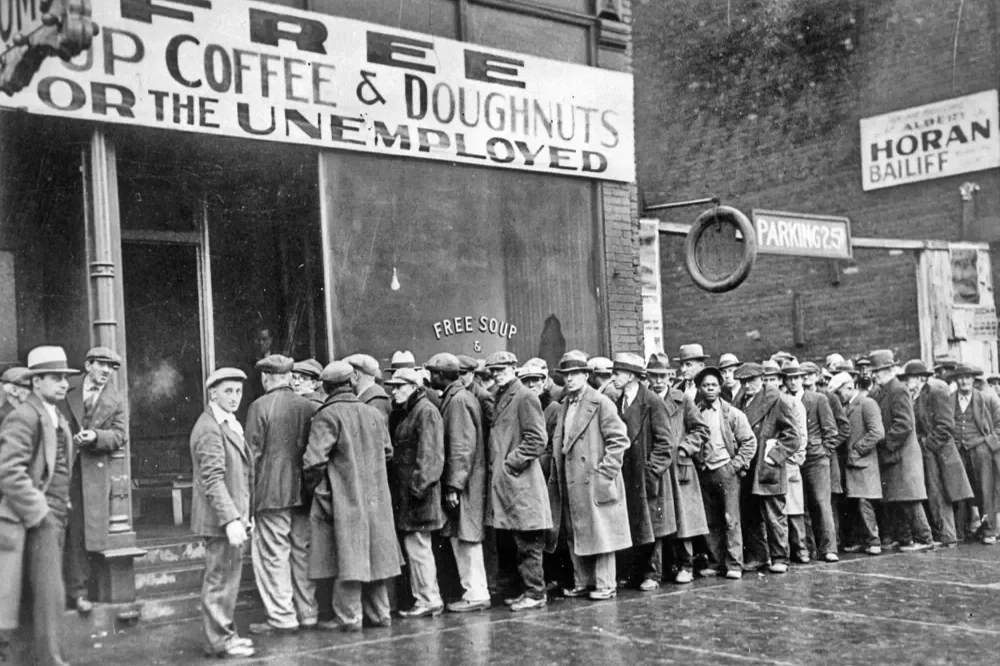
Great Depression: Soup Kitchen, Everett Collection, courtesy of Encyclopædia Britannica
In the first year after the fall of the table-men and the money changers, chaos was ordinary. The cement jungle shook with fear, soaked and streaked with black ice. Graphs turned downward in an angry crimson, casting a vicious glow on the gaunt faces of the people. Voices of authority crackled from the radios, assuaging no fear. Their warm tones and gentle words couldn’t feed a starving belly, and so they couldn’t be worth a thing.
He could not pretend to put on any kind of positivity in such conditions, but still he prayed, knees shivering against the freezing linoleum, dusty with grime and covered in patchwork clothes. It couldn’t be long now. A good God would fix this, given time. A good God would never leave a faithful man— no, a thousand faithful men— shivering and begging and crying through the night. So he prayed.
In the twilight hours between fruitless wakefulness and fitful sleep, as his hands curled into his blanket pulled against him, a warmth curled over his knuckles, startling him almost more than the blinding light that engulfed his vision. Without warning or explanation, he was swept from his relative comfort to the intersection of Wall and Broad Street, squinting through the thick flurries. The scene unfolded before him, and he trembled.
The First Vision
The unbreakable have broken and
the certain are certainly lost and
the assured is unknown
The stones of power and order crumble and
the weight of brick and debt on the lambs
the weight the weight The Wait
is unbearable
O, those lines of lambs begging for wheat
and on and on and on and—
the lambs fall and they fight and they reap the consequence of
The wolves among them and
the sword of greed on which they were sacrificed.
the sip of wrath and the swig of gluttony on the wolf’s stained lips
and the glitter of jewels strangling their necks as their avarice has strangled them
And for the lambs:
the days and lines of squalor grow
The ravens in their towers watch the runs
watch the desperate ones
tearing the flesh from the foundations of marble and pride and
pulling them crashing to the ground
The chaos brings no security but
cold. wretched.
despair.
/
He came to in a desperate, cold sweat, vision blurred as he panted, taking in the freezing air like sharp knives down his throat. “Oh, God, what have You done? The people– Oh, God, the people!” His breathing would not slow. “Was this meant to answer my prayer? This tragedy, this… abomination?! A punishment? For whom?! For those who oppressed the righteous? Those lowly men live in their high towers, insulated from the cruelty of desperation. You harm the righteous themselves.”
The angel stepped from the shadows, resting on the edge of the bed. “Why do you challenge the One who created you?”
Fearing had no more incredulity to give, simply looking up blearily. “Why do I serve an evil God?” His words had bite, and he hoped that they stung. The images he’d seen…
The angel interrupted his thoughts. “Who are you to define your Master?
He shook his head. “Who are you to defend Him?”
They rose smoothly, seemingly unaffected. “You are human.” A gesture to the window. “They are human. You may not understand the mechanisms of the divine, but surely you yearn for justice, don’t you? At least for yourself? You have been wronged, no?”
He thought back to his parents, shuffling him back and forth like a package through his childhood. He thought of the resignation letter he was forced to leave on the front desk of the literary magazine he used to head. He thought of the shabby apartment, the disintegrating clothing, the parties of the rich on the high balconies of splendor lifted above the squalor of the street, the dark entrance to his complex. His throat closed in anger. “Yes. Yes, I have been wronged.”
The angel inclined their head in assent. “You think of these times, of course. You are human,” they repeated. “But you, too, have wronged, and you do not find fault with your lack of punishment.”
He tensed, the flashes coming unbidden. Margery. Oh, Margery. Clinging to him, suffocating him, driving him to— well, it was her fault, really, that he had strayed. There was nothing to her by the end. Nothing that could compel him to make her a wife. And there were so many other women in the world.
“Oh, Son of Adam. How predictable you are— all of you, every single time. And you sit here to lecture me on evil. Your God works above your pitiful attempts at morality— a framework you cannot even work out in yourself. He is not without judgment, yet He is not without mercy. Some must bleed to dye the robe of royalty, yes. The measure of martyrs must be fulfilled. But He has allotted times for mercy as well as times for judgment. Time is laid out and marked by His will, as it has been since the beginning of the world. As it has been since Adam fell. You cannot see, and so you must experience.”
The next night, the visions came again.
The Second Vision
Clouds rolling in
thick brown waves
(a snake weaves its way toward them)
and tripping and falling
over and into and beyond the
grain. grapes. bodies.
It would be beautiful, in another world.
(he smiles and offers)
The sheep watch it
rushing toward them
and they bite necks and butt heads
(pull the fruit from the tree)
and slash and kill to make it
(juice spills from the bite)
out, the biters turned soot black
and the bitten turned white as snow
and red as blood.
The wolves dance and
the ravens watch and
The plain pulls and stretches and
now the sheep face each other
battle lines mirroring the colors
light and dark, so close to identical, and
yet.
/
He woke with a gasp, hand to his throat. He could feel the biting, tearing creatures, the sheer fear of it all. And worst of all, he’d wanted to tear out their throats, too. The angel just watched, perhaps a ghost of a smile lingering on their lips. “So you see, you serve a just God.”
It was all Fearing could do not to scream. His head spun, the vision seeping into his every instinct. “But it wasn’t the sheep who started this. That beggar on the street out there— he didn’t ask for starvation! If he lashes out, that isn’t his fault!”
The angel set hands on the windowsill, turned away. “Isn’t it, though? If he does such things, he should be punished, shouldn’t he? A moral line cannot shift simply on circumstance. If it was you who received the lashings, I fear you’d have a different answer.”
Fearing had nothing to say, swallowing hard.
They tapped a lively rhythm out on the sill. “It is simply the nature of the fruit, the instruction of the Watchers. Humans must be kept in line— your lot will return to eat your vomit over and over again if you are allowed. Your Creator knows this, Kenneth. This is why you have been given this burden, this gift. The people must know what they do. They must know that they will live to see the end, and that they will be judged.”
And truly, when he thought of it— when he really looked around the backdrop of his life, this New York City— he could see that black sludge of sin in everything. The brawls and the blood smeared on white snow beside a bowl of overturned, fought-over stew. The sneering words thrown mercilessly, brother on brother, from starving mouths. And yes, they were hungry, and yes, they were hurting. But perhaps the hunger simply distilled them to their truest form, and perhaps that truest form was awful. Perhaps he was awful. And sin was sin, no matter how disguised. So these scenes to come, maybe they really were a mercy: it was a necessity that they know that God’s judgment was imminent. Maybe they didn’t deserve it, but maybe they did.
He should apologize to Margery, he thought suddenly. He should do many things. He pushed off the covers, shivering over to his workstation. With the nicest pen he owned and the first scrap paper he could find, Fearing scribbled what he’d seen across the yellowing pages over old, crossed-out lines of half-baked poems. Stupid, stupid. Wastes of time, all of them. None of it mattered anymore.When he looked up, he was once again alone.
This time, divinity caught him at his desk, frantically attempting to recall and copy down all the symbols he had seen. The visions, unrelenting, came once more.
The Final Vision
But lo! The trial is in view
the brown clouds
split by the bloody robe and sandals
the air cleaned, the stones in place
the broken bodies underfoot, a sword in hand
standing atop the martyrs and holding court
The books open all at once
The animals corralled
The eyes watching
And the writing and the culling begins
and the trial plods on:
wolves: slain, thrown in the fires
ravens: evaluated
sheep: punished
fur assessed . . .
white: proceed to book
black: [see ‘wolves’]
America: new
Final kingdom? restored.
(do not look at the fires.)
The plain stretches out
golden and marshy and desert and sky and
O, the splendor! the harvest!
it is the vastness and the power and the
peace of all for the righteous
the down turned up and the origins restored
distilled to simplicity and to light
The fruits no longer poison
the grain not glazed with grime and
the white sheep graze on grasses and
through forests and
O, the trees!
The end of the world, yes.
(do not look at the fires).
the start of a time.
/
Fearing set down his pencil.
Author’s Note: This piece is styled upon works of Ancient Jewish apocalypse, and it is set in the midst of the Great Depression in New York City, with the revelation received in January of 1930 (the ‘crisis point’) and the various prophetic visions spanning from 1930 through 1936, the most severe years of economic hardship.
The man receiving the revelation, Kenneth Fearing, was a poet living in New York City at the time who wrote extensively about the horrors of the starvation and desperation of the city. Because many Jewish apocalypses are written in poetry, I wanted to attempt to translate the medium by utilizing Fearing’s poetic style in the vision portions of the piece. Additionally, we often turn to art in times of darkness to explain and explore what is happening, so I felt that the revelation coming to an artist was a particularly poignant concept. Fearing was also a man with a deeply chaotic personal life, characterized by his isolation and particular life events referenced in the piece, which made him a uniquely interesting character through which to explore themes of morality.